Passkey-first accounts
WebAuthn plus a generated private-key fallback. The server stores a public key or a SHA-256 fingerprint, never a login secret.
The most complex application we have shipped: a public document that people can read, cite, propose changes to and vote on — with passkeys, versions, moderation and an audit trail.
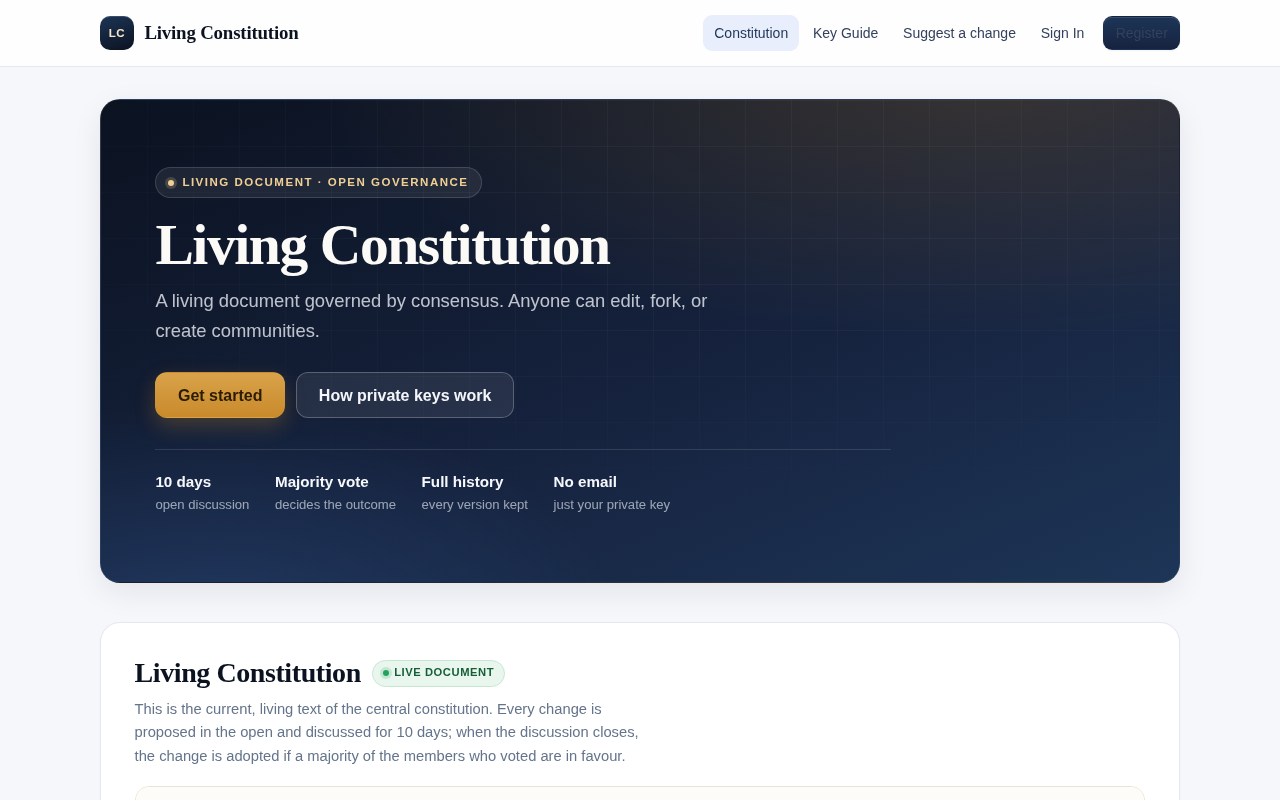
A visitor can read the constitution, follow a citation, propose a change, discuss it and see the result. Every step leaves a record.
WebAuthn plus a generated private-key fallback. The server stores a public key or a SHA-256 fingerprint, never a login secret.
Random, hashed tokens with HttpOnly, SameSite=Strict cookies, CSRF checks and exact-origin enforcement.
Every authoritative save creates an append-only version with author, note and a reversible diff.
Public submissions wait in a review queue; privileged and destructive actions write an audit row.
Self-hosted assets, local full-text search and a service worker, so the document works without a network.
A run script, liveness/readiness probes, encrypted SQLite backups, a smoke test and a rollback path.
The page is the easy part. The application has to keep identity, consent, versions and money honest while remaining readable to a non-technical visitor.
It is the same design discipline with more surface area: auth, data, money and operations.
Routes, roles, uploads, payments and the boundaries between them, written down before code.
Auth wiring, CSRF, moderation, versions, audit, payments and a real-browser passkey round trip.
Run script, health probes, backups, restore test and a previous image for rollback.
Repository, environment names, runbook and a recorded walkthrough — no black box.
A short discovery tells us whether the idea is a form, a storefront or a platform. We will say which — and what it costs.